
If you need senior marketing leadership but a full-time chief marketing officer is more than you can justify, the choice usually comes down to three options: a fractional CMO, a marketing agency, or a full-time hire. The short version: a fractional CMO gives you strategy and ownership part-time, an agency gives you execution and specialist hands, and a full-time CMO makes sense once marketing is core to the business and there is enough of it to keep a senior leader busy. Most of the confusion comes from treating them as the same purchase. They are not.
I work as a fractional CMO, so I have an interest here, and I would rather be honest about it than sell you the wrong thing. There are businesses I turn away because an agency or a full-time hire is genuinely the better fit. Here is how I would think it through if I were in your seat.
The three options, in plain terms
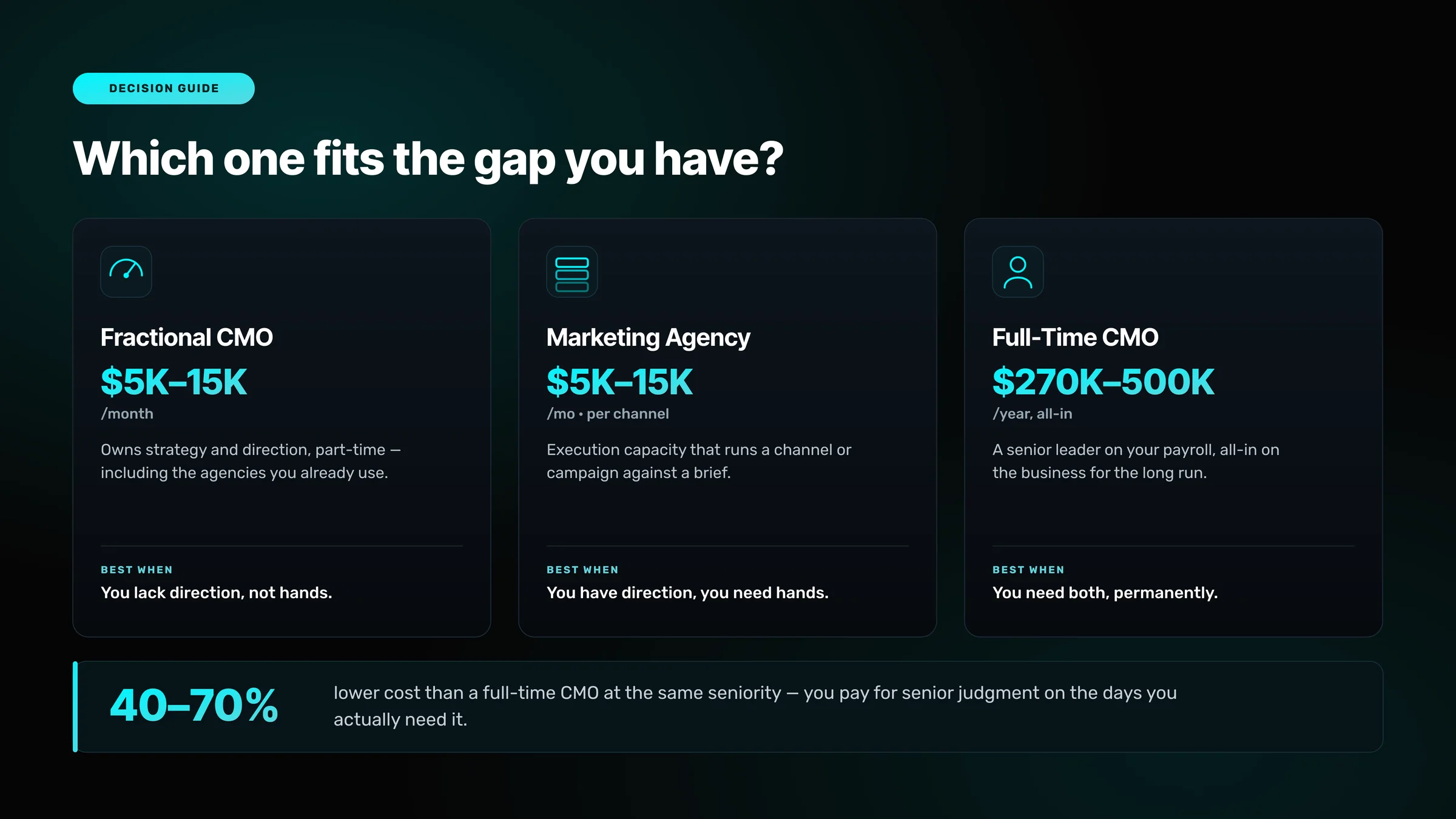
A fractional CMO is a senior marketing leader who works with you part-time, usually a set number of days a month. They own strategy, set priorities, and hold the whole function accountable to revenue, including any agencies and freelancers you already use. A marketing agency is execution capacity: a team that runs a channel or a campaign well, like SEO, paid media, or content, usually against a brief someone else has set. A full-time CMO is exactly what it sounds like, a senior leader on your payroll, all-in on your business.
The simplest way to tell them apart is to ask what is actually missing. If you lack direction, you need a CMO of some kind. If you have direction but not enough hands, you need an agency. If you need both, full-time and for the long run, you need to hire.
What each actually costs
Prices vary, but the 2026 ranges are clear enough to plan around. A fractional CMO typically runs between 5,000 and 15,000 US dollars a month, with senior operators and enterprise scope going higher. A specialist agency tends to land in a similar band per channel, roughly 5,000 to 15,000 a month for one discipline done well, and more as you add channels. A full-time CMO is the big one: base salaries sit around 225,000 dollars in mature markets, but the real employer cost, once you add benefits, bonus and equity, is closer to 270,000 to 500,000 a year.
| Option | Typical cost (2026) | What you get |
|---|---|---|
| Fractional CMO | ~$5k to $15k / month | Senior strategy and ownership, part-time |
| Agency | ~$5k to $15k / month per channel | Execution capacity in one discipline |
| Full-time CMO | ~$270k to $500k+ / year all-in | A senior leader fully on your team |
The headline is that a fractional CMO usually costs 40 to 70 per cent less than a full-time one at the same level of experience, because you are buying their judgment for the days you actually need it rather than their whole week. In the GCC the maths is similar, with senior in-house marketing leaders commanding strong packages that only make sense once the workload justifies them.
When a fractional CMO is the right call
A fractional CMO fits best when the gap is leadership, not labour. You might have a capable team or a couple of agencies but nobody senior setting direction and holding it all together. You might be scaling and feeling the cost of decisions made without a strategist in the room. You might be between full-time CMOs and need someone to steady the function. Or you might simply want a senior pair of hands on the wheel a few days a month, without committing to a six-figure salary before the business is ready. In all of those, you are buying judgment and accountability, which is exactly what part-time seniority is good at.
When an agency makes more sense
If your strategy is already clear and what you actually lack is delivery, an agency is often the cleaner answer. You know you need consistent SEO, or a paid-media programme run properly, or a content engine that ships every week, and you want a specialist team to own that lane. Agencies are built for depth in a channel and for scaling output. Where they struggle is cross-channel strategy and honest, business-wide accountability, because they are usually measured on their slice rather than your revenue. If nobody on your side is setting and owning the brief, an agency on its own will run hard in a direction nobody actually chose.
When to just hire full-time
Sometimes the right move is the expensive one. If marketing is the engine of your business, if there is genuinely enough strategic and operational work to fill a senior leader’s week, and if you can carry the full cost without starving the rest of the plan, a full-time CMO is worth it. The usual mistake is hiring one too early, before the role is full, and then watching an expensive executive spend half their time on work a coordinator could do.
It is often not either/or
The most common setup I run is not a contest between these three, it is a combination of them. A fractional CMO sets the strategy and owns the numbers, while one or more agencies execute the channels underneath, with the CMO managing them so you do not have to. You get senior direction and real delivery capacity without a full-time salary, and the agencies finally have someone on the client side who can brief them properly and hold them to outcomes. For a lot of growing businesses in Qatar and the wider GCC, that pairing is the sweet spot.
Frequently asked questions
Is a fractional CMO cheaper than a full-time one?
Usually yes, by something like 40 to 70 per cent at the same level of experience, because you pay for the days you need rather than a full salary, benefits, bonus and equity. The saving only holds if the role genuinely does not need a full-time leader yet.
Can a fractional CMO replace my agency?
Not really, and a good one will not try to. A fractional CMO sets strategy and owns outcomes; an agency executes a channel at depth. The strongest setup is usually a fractional CMO directing one or more agencies, not one in place of the other.
How many days a month does a fractional CMO work?
It varies with the business, but a few days a month is common, scaled up during launches or heavy periods and down once things are running. The point is senior input where it matters, not presence for its own sake.
When should I switch from a fractional CMO to a full-time one?
When the work reliably fills a full week and marketing has become central enough that you want someone all-in on the payroll. A good fractional CMO will tell you when you have reached that point, and often help you hire their replacement.
Does this model work for a business in Qatar or the GCC?
Yes. The economics are the same, and the model suits the region well, where senior, trilingual marketing leadership is expensive to hire full-time but valuable to have part-time, especially for brands scaling across the GCC and beyond.
Not sure which one you need?
That is usually a thirty-minute conversation, not a guess. See how I work as a fractional CMO in Qatar, look at the results I have delivered, or book a free call and I will tell you honestly whether a fractional CMO, an agency, or a full-time hire is the right next step, even if it is not me.